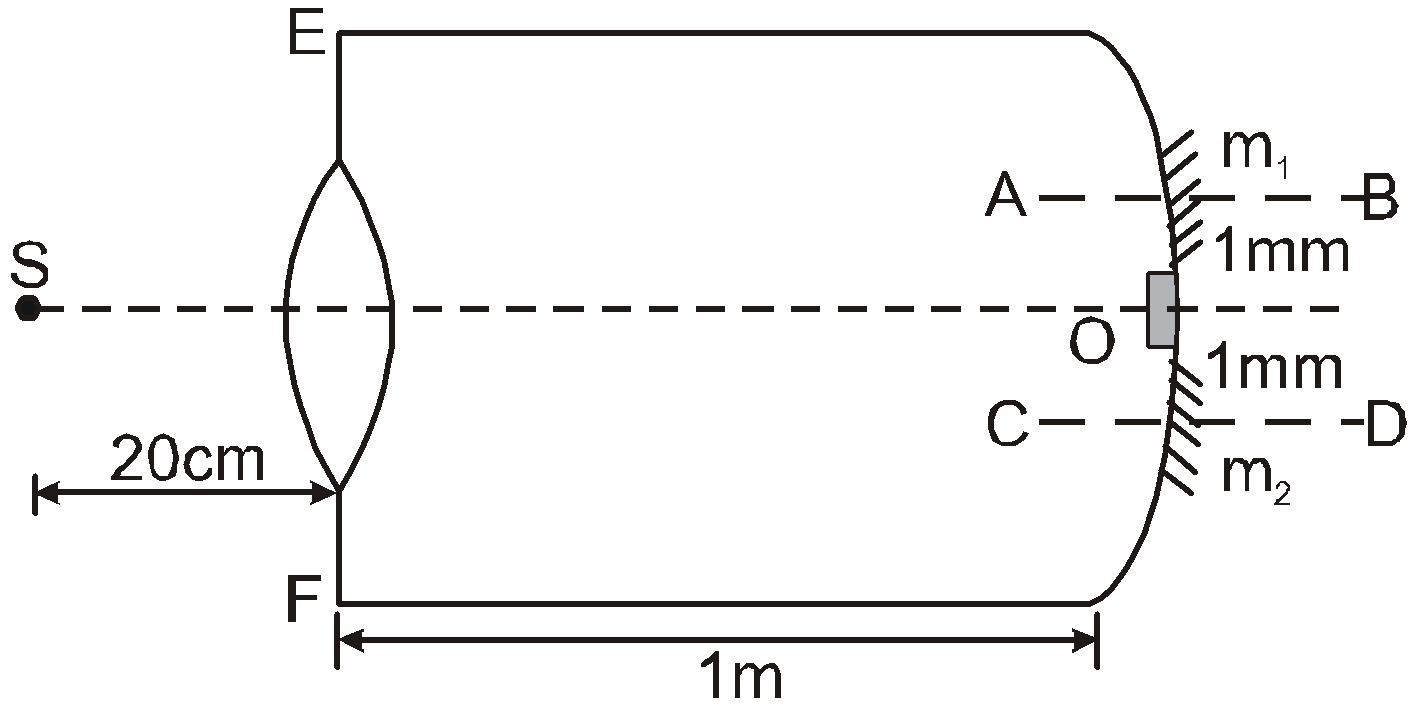
An equi convex lens of focal length 10 cm (in air) and R.I. 3/2 is put at a small opening on a tube of length 1 m fully filled with liquid of R.I. 4/3. A concave mirror of radius of curvature 20 cm is cut into two halves m 1 and m 2 and placed at the end of the tube. m 1 & m 2 are placed such that their principal axis AB and CD respectively are separated by 1 mm each from the principal axis of the lens. A slit S placed in air illuminates the lens with light of frequency 7.5 × 10 14 Hz. The light reflected from m 1 and m 2 forms interference pattern on the left end EF of the tube. O is an opaque substance to cover the hole left by m 1 & m 2 . Find :
Text Solution
Verified by ExpertsCHECK THE SOLUTION.
80 cm behind the lens
4 mm β = 60 μ m
Sol. Lets find out the radius of curvature of equi. convex lens.
 ⇒
⇒  ⇒ R = 10 cm.
Now 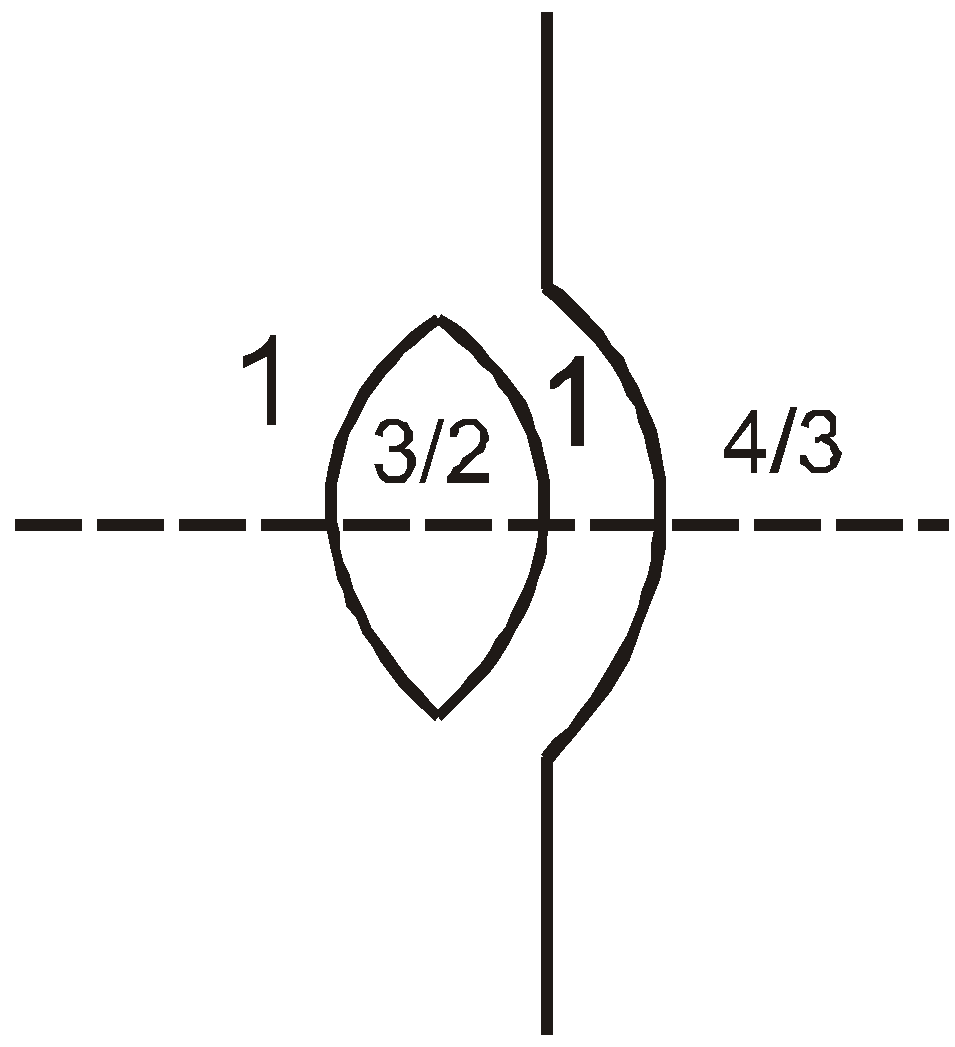
for lens
 ⇒
⇒ 
⇒ for surface of tube (of R = 10 cm.)
 ⇒
⇒  ⇒ V = + 80 cm.
Now for mirrors. 
As the object for the mirrors is at 20 cm so the image will be at 20 cm only
u = – 2 f ⇒ v = – 2f also.
⇒ magnification = m = 
⇒  ⇒ y I = + (1 mm)
so the final images are like.

so the distance between the images is 4 mm.
Now, these I 2 and I 4 behave as the 2 sources for fringe pattern.
⇒ β =  =
=  =
= 
=  = 60 μ m.
Prepare Smarter with CGP Edu
Get practice questions, solutions, and test series in one place.
Write a Review
Share your experience with this question and solution.
Commentary
Send your comment, doubt, correction, or feedback to admin.
Similar Questions
Explore conceptually related problems